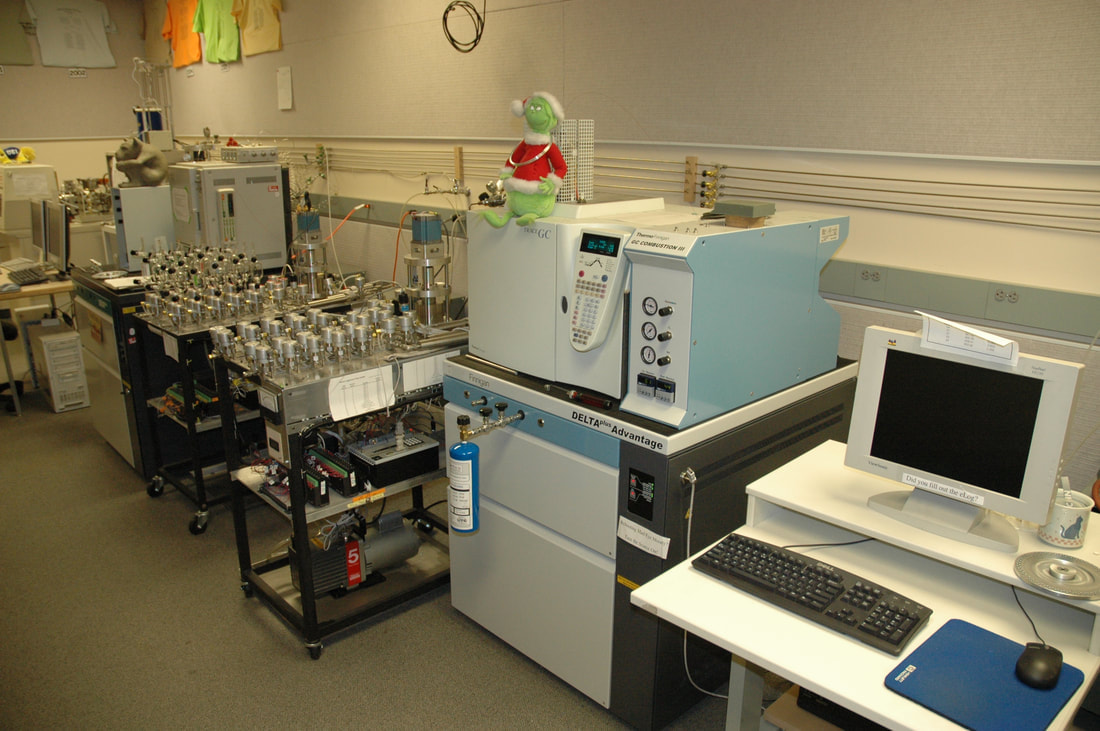


Research in the Ehleringer Lab is directed at answering three ecological questions of societal relevance. First, how does drought influence carbon cycles in ecosystems of the western US? Second, how do humans and our choices influence carbon and water cycles in urban ecosystems? Third, how can stable isotopes analyses inform us about process related to human activities, our movements, and dietary choices?

In the News


NOW ACCEPTING APPLICATIONS FOR STABLE ISOTOPES COURSES In addition to the 18th annual offering of the Stable Isotope Biogeochemistry and Ecology course (aka “Iso-Camp”) this year, we are introducing a new companion course, Isotopes in Spatial Ecology and Biogeochemistry (aka “The SPATIAL Short Course”), focused on large datasets, spatial analysis and modeling, and scaling with isotopic data.
SIE News Measuring co2 to fight global warming. Jiim Ehleringer and colleagues have developed a method which could reliably detect changes in CO2 of 15% or more. Potential climate treaties would necessarily rely on the ability to verify CO2 emissions. Ehleringer did the study with four Massachusetts atmospheric scientists: Kathryn McKain and Steven Wofsy of Harvard University, and Thomas Nehrkorn and Janusz Eluszkiewicz of Atmospheric and Environmental Research, Inc.
SIE NewsIsoCamp 2011 is now finished! The 16th annual Stable Isotope Biogeochemistry and Ecology course in June was a resounding sucess. 37 graduate students and postdocs from around the world attended this year's lecture and lab classes. Another 6 students from Utah participated in the lectures. 16 instructors from across the USA provided stimulating lectures and inspired students.
EnvirovanEnviro-van is coming. As part of a Department of Energy research award, the Ehleringer Lab is developing a mobile laboratory for continuous measurements of trace gas species relevant to understanding climate change and the carbon cycle. Molecular species to be measured online include carbon dioxide, carbon monoxide, methane, water vapor, and ozone. Stay tuned for more details and look for this mobile lab in your neighborhood.
diabetesStable isotopes and diabetes. Stable isotopes reveal the magnitude of changes in water balance of diabetic mice. In a recent publication from the Ehleringer Lab, Shannon O'Grady and colleagues showed that changes in water metabolism and excessive water consumption can be detected and quantified with stable isotope ratio measurements long before glucose intolerance becomes manifested.
co2 Carbon dioxide, stable isotopes, and ecosystems. Jim Ehleringer has just given a series of lectures on how stable isotope analyses of atmospheric carbon dioxide help unravel source/ sink dynamics in ecosystems at regional scales. In particular stable isotopes are proving useful in quantifying stress within ecosystems and sorting out the regional importance of various anthropogenic inputs across complex landscapes.
See all news items...